

CELPIP Reading practice test with answers
A full free CELPIP Reading test: 4 parts and 39questions with every passage, and the answer to every question with an explanation of why it's right. For a timed score, take it in the exam simulator first, then study it here.
Updated · CelpipUni Academic Team
On this page3 sections
How to use this test
- Set a timer for about an hour and work through all four parts without opening the answers.
- Check your answers with the key at the bottom and count your raw score.
- Read the explanation for every question you missed: most wrong answers repeat words from the passage but change the meaning.
Part 1: Reading Correspondence
Cultural Festival Planning Update · 12 questions
Read the following message.
To: Community Volunteers List volunteers@community.org
From: Sarah Chen, Lead Organizer sarah.chen@cityevents.ca
Subject: Cultural Festival Planning Update & Volunteer Request!
Date: October 26, 2023
Hello everyone,
Hope this email finds you well! I'm thrilled to share an exciting update on the planning for our annual Spring Cultural Festival, scheduled for Saturday, May 18th, 2024, from 10:00 AM to 6:00 PM at Lakeside Park. We've made significant progress, and thanks to the dedication of our core team, all major permits are secured, and the main performance stage is officially booked. This year promises to be our biggest and best yet, celebrating the diverse heritage of our city!
However, as we move into the final stages, our volunteer needs are growing. We're specifically looking for enthusiastic individuals to assist with several critical areas:
- Setup & Takedown Crew: Strong individuals needed on May 17th (afternoon) and May 18th (evening) for equipment handling and site preparation/cleanup. Experience with minor carpentry or event logistics is a bonus.
- Cultural Booth Coordinators: Help manage the flow and needs of our various cultural exhibition booths throughout the day on May 18th.
- Children's Activity Zone Leaders: Engage with families and supervise activities like face painting and craft tables. Prior experience with children is highly valued.
- Information & Wayfinding Ambassadors: Provide directions, answer general questions, and distribute festival programs. Must be friendly and knowledgeable about the festival layout.
- Marketing & Social Media Support: Assist with pre-festival promotion by sharing posts, creating content, and engaging with our online community. This role can be done remotely until May 10th.
If you are interested in contributing, please reply to this email by November 15th indicating your preferred role(s) and availability. Training sessions for specific roles will be scheduled in early April. For any detailed questions about a particular role, please contact Mark Johnson at mark.johnson@cityevents.ca, our Volunteer Coordinator.
Thank you in advance for your invaluable support in making this year's festival a resounding success!
Best regards,
Sarah Chen
Lead Organizer, City Events Committee
Using the drop-down menu, choose the best option according to the information given in the message.
Question 1: What is the primary purpose of Sarah Chen's email?
- A. To announce the final schedule for volunteer training sessions in April.
- B. To inform the community about the festival's new location and date.
- C. To provide an update on festival planning and request volunteer assistance.
- D. To confirm the booking of the main performance stage and necessary permits.
Show the answer and why
Answer: C (To provide an update on festival planning and request volunteer assistance.)
The email starts by providing an update on the festival planning and then clearly requests volunteers for various roles. Options a, b, and d are all mentioned in the email but represent specific details or secondary purposes, not the overarching primary purpose. Tip: Always look for the main idea that encompasses all major points of the correspondence.
Question 2: According to the email, which of the following tasks can be completed before the festival day and potentially off-site?
- A. Managing the cultural exhibition booths.
- B. Supervising children's craft tables.
- C. Assisting with pre-festival online promotion.
- D. Handling equipment for event setup.
Show the answer and why
Answer: C (Assisting with pre-festival online promotion.)
The 'Marketing & Social Media Support' role description explicitly states: 'This role can be done remotely until May 10th.' The other options describe tasks that require physical presence on the festival day or immediately before/after. Tip: Pay close attention to specific details like dates and locations mentioned for each task.
Question 3: What is the deadline for volunteers to express their interest in participating in the festival?
- A. May 10th
- B. May 18th
- C. November 15th
- D. Early April
Show the answer and why
Answer: C (November 15th)
The email states, 'If you are interested in contributing, please reply to this email by November 15th.' May 10th is a deadline for remote marketing, May 18th is the festival date, and early April is when training sessions will be scheduled. Tip: Distinguish between different dates and their associated actions.
Question 4: Volunteers with experience in minor carpentry would be particularly useful for which role?
- A. Cultural Booth Coordinators
- B. Setup & Takedown Crew
- C. Children's Activity Zone Leaders
- D. Information & Wayfinding Ambassadors
Show the answer and why
Answer: B (Setup & Takedown Crew)
Under the 'Setup & Takedown Crew' description, it notes: 'Experience with minor carpentry or event logistics is a bonus.' This specific skill is not mentioned for any other role. Tip: Scan the descriptions of each volunteer role for keywords related to the question.
Question 5: Who should be contacted for specific, detailed questions about a particular volunteer role?
- A. Sarah Chen, Lead Organizer
- B. The Community Volunteers List
- C. Mark Johnson, Volunteer Coordinator
- D. The City Events Committee
Show the answer and why
Answer: C (Mark Johnson, Volunteer Coordinator)
The email clearly states: 'For any detailed questions about a particular role, please contact Mark Johnson at mark.johnson@cityevents.ca, our Volunteer Coordinator.' Sarah Chen is the Lead Organizer, but Mark is the specific contact for role-related queries. Tip: Identify the specific contact person for different types of inquiries.
Question 6: What is explicitly stated as already being accomplished by the core team?
- A. All volunteer training sessions have been scheduled.
- B. The festival's diverse heritage theme has been finalized.
- C. All major permits are secured and the main stage is booked.
- D. The complete list of cultural exhibition booths is confirmed.
Show the answer and why
Answer: C (All major permits are secured and the main stage is booked.)
The email states, 'all major permits are secured, and the main performance stage is officially booked.' Training sessions 'will be scheduled' (not already scheduled), the theme is mentioned but not as a recent accomplishment, and the list of booths is not explicitly confirmed. Tip: Look for phrases that indicate completion or current status, such as 'are secured' or 'is booked'.
Here is a response to the message. Complete the response by filling in the blanks.
To: Sarah Chen, Lead Organizer sarah.chen@cityevents.ca
From: [Your Name] volunteer@email.com
Subject: Re: Cultural Festival Planning Update & Volunteer Request!
Date: October 28, 2023
Dear Sarah,
Thanks so much for the update on the Spring Cultural Festival! It sounds like everything is coming along wonderfully, and I'm really excited to be a part of it again this year.
I'd be happy to volunteer my time. I'm particularly interested in the Marketing & Social Media Support role, as I have some experience with online promotion and content creation. I could definitely (7) ______ until May 10th. I'm also available to help on May 18th if there are any (8) ______ needs that day, perhaps assisting with the Information & Wayfinding Ambassadors.
Could you please clarify if the remote marketing role (9) ______ to a minimum number of hours per week? I want to ensure I can fully commit. Also, I noticed the email mentioned training sessions in early April; will the schedule for those be (10) ______ closer to the date?
I look forward to hearing from you and contributing to what will surely be a (11) ______ success. I will make sure to reply by the (12) ______ of November 15th.
Best regards,
[Your Name]
Question 7 (blank)
- A. manage the website
- B. assist with pre-festival promotion
- C. coordinate all social media
- D. lead the online community
Show the answer and why
Answer: B (assist with pre-festival promotion)
The original email describes the Marketing & Social Media Support role as 'Assist with pre-festival promotion by sharing posts, creating content, and engaging with our online community.' Option 'b' most accurately reflects this description. Options 'a', 'c', and 'd' imply a higher level of responsibility or a more specific task not explicitly offered. Tip: Choose the option that most closely matches the wording and scope of the original message.
Question 8 (blank)
- A. additional on-site
- B. different remote
- C. main stage
- D. permit handling
Show the answer and why
Answer: A (additional on-site)
The volunteer is already interested in a remote role, so offering to help with 'additional on-site' needs on the festival day makes the most sense in context. 'Different remote' is contradictory for May 18th. 'Main stage' and 'permit handling' are too specific and don't fit a general offer of help. Tip: Consider the overall context of the volunteer's offer and the nature of the tasks mentioned in the original email.
Question 9 (blank)
- A. requires adherence
- B. is subject
- C. pertains
- D. involves
Show the answer and why
Answer: B (is subject)
The phrase 'is subject to' is the most natural and grammatically correct way to ask if a role has a condition or requirement, such as a minimum number of hours. 'Requires adherence' is too formal. 'Pertains to' or 'involves' don't convey the sense of a requirement as clearly. Tip: Think about common English idioms and phrasal verbs that fit the meaning of a condition or requirement.
Question 10 (blank)
- A. announced
- B. confirmed
- C. determined
- D. publicized
Show the answer and why
Answer: A (announced)
When asking about when a schedule will be shared, 'announced' is the most common and appropriate verb. While a schedule might be 'confirmed' or 'determined' internally, it is 'announced' to the public or volunteers. 'Publicized' is similar but often used for broader events rather than specific internal schedules. Tip: Consider the typical verb used when sharing information like schedules or dates.
Question 11 (blank)
- A. grand
- B. significant
- C. resounding
- D. remarkable
Show the answer and why
Answer: C (resounding)
The original email from Sarah Chen concludes with 'in making this year's festival a resounding success!' Using 'resounding' in the reply maintains consistency with the tone and specific phrasing of the initial message, which is a common practice in email correspondence. Tip: Look for opportunities to echo specific positive language used in the original message to maintain a consistent tone.
Question 12 (blank)
- A. deadline
- B. latest
- C. end date
- D. cutoff
Show the answer and why
Answer: A (deadline)
The original email states, 'please reply to this email by November 15th,' which refers to a submission deadline. Therefore, 'deadline' is the most accurate and natural word to use in the reply. While 'latest,' 'end date,' and 'cutoff' are similar, 'deadline' is the most standard term in this context. Tip: Choose the most precise and common term for time-sensitive submissions.
Part 2: Reading to Apply a Diagram
Wildlife Park Visitor Trail Map · 8 questions
Subject: Our Zoo Trip Plan!Hi Sarah,Just got the map for Wilderness Wonders Wildlife Park! It looks like fun.I was thinking we could aim to get there right when it opens, so we have plenty of time. My nephew, Leo, is obsessed with lions, so that should be our first stop. After that, I'd love to catch the monkeys' feeding session, as I heard they're quite active then.We'll definitely need a lunch spot. The map shows two picnic areas; I think the one near the lake sounds nice, especially if the weather is good. It also seems like it's fairly close to the Lion Habitat, which would be convenient after we visit them.I also saw they have an Observation Deck near the Bears, which could be a good final stop before we head out. We should check the feeding times for both the lions and the bears to make sure we don't miss anything. Also, don't forget to remind Leo about the "no outside food" rule when we're near the animals, especially since he always tries to share his snacks!Let me know what you think of this plan.Best,Jessica
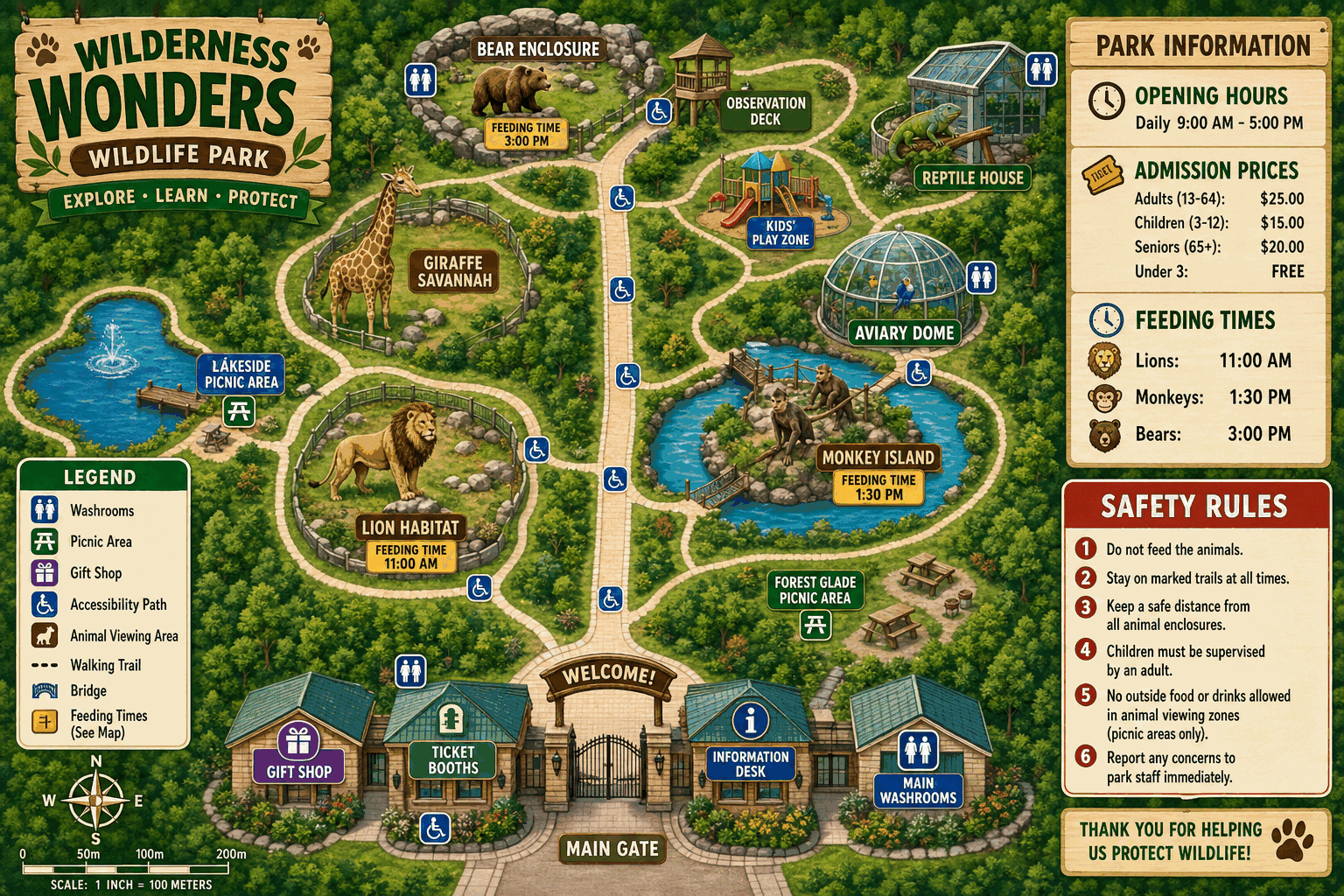
Read the email and refer to the park map (diagram) to answer the following questions.
Question 13: Based on Jessica's plan, what time should they aim to arrive at the park?
- A. 11:00 AM
- B. 1:30 PM
- C. 9:00 AM
- D. 3:00 PM
Show the answer and why
Answer: C (9:00 AM)
Jessica states, "I was thinking we could aim to get there right when it opens". The diagram indicates the park's opening hours are "Daily 9:00 AM - 5:00 PM". Therefore, they should aim to arrive at 9:00 AM. Tip: Always cross-reference information from both the text and the diagram to find the correct answer.
Question 14: If Jessica and Sarah follow their plan to see the lions first, then the monkeys' feeding, and then lunch at the Lakeside Picnic Area, what would be the most logical next animal viewing stop if they want to see a feeding?
- A. Giraffe Savannah
- B. Aviary Dome
- C. Bear Enclosure
- D. Reptile House
Show the answer and why
Answer: C (Bear Enclosure)
Jessica's plan includes seeing the lions (feeding at 11:00 AM) and the monkeys' feeding (1:30 PM). She also mentions the Observation Deck near the Bears as a potential final stop and checking bear feeding times. The diagram shows Bear feeding at 3:00 PM. Given that they are planning to have lunch after the monkeys, the Bear Enclosure feeding at 3:00 PM would be the next logical feeding event to catch. Tip: Trace the group's likely path and timing based on the email and compare it with the diagram's schedule.
Question 15: Which safety rule is Jessica specifically reminding Leo about, based on her email?
- A. Stay on marked trails
- B. Children must be supervised
- C. No outside food or drinks in animal viewing zones
- D. Keep a safe distance from enclosures
Show the answer and why
Answer: C (No outside food or drinks in animal viewing zones)
Jessica explicitly states, "Also, don't forget to remind Leo about the 'no outside food' rule when we're near the animals, especially since he always tries to share his snacks!". This directly corresponds to Safety Rule #5 on the diagram: "No outside food or drinks allowed in animal viewing zones (picnic areas only)". Tip: Look for direct quotes or clear paraphrasing from the email that matches specific rules on the diagram.
Question 16: What is the total admission cost for Jessica, Sarah, and Leo (assuming Leo is 7 years old)?
- A. $55.00
- B. $65.00
- C. $70.00
- D. $80.00
Show the answer and why
Answer: B ($65.00)
The diagram states Admission Prices are: Adults: $25.00, Children (3-12): $15.00. Jessica and Sarah are adults (2 x $25.00 = $50.00). Leo is 7 years old, so he qualifies as a child ($15.00). The total cost would be $50.00 + $15.00 = $65.00. Tip: Identify the categories of each person mentioned and apply the corresponding prices from the diagram.
Question 17: After visiting the Lion Habitat, which of the following paths would be accessible for someone using a wheelchair to reach the Monkey Island for their feeding time?
- A. The main central path leading east
- B. A direct trail from the Lion Habitat to Monkey Island
- C. Any path from the Lakeside Picnic Area
- D. Only a staff-only path
Show the answer and why
Answer: A (The main central path leading east)
The image prompt specifies that "The main central path and all paths leading to major animal habitats... are accessible paths (marked with wheelchair symbol)". To get from the Lion Habitat (west side) to Monkey Island (east side), one would need to use the main central path that connects the different sections of the park. Tip: Understand the park layout and the explicitly marked accessible routes on the diagram.
Complete Sarah's email reply by filling in the blanks with the correct information from the park map (diagram) and Jessica's email.
Subject: Re: Our Zoo Trip Plan!Hi Jessica,Sounds like a great plan! I agree, getting there at opening is smart. I've noted the lion and monkey feeding times. The Lakeside Picnic Area sounds perfect for lunch, and it's good that it's near the Lion Habitat.Regarding the Observation Deck, I think it's a great idea for a final stop. We should aim to get there before (18) ______ so we don't miss the feeding. Also, I'll make sure to remind Leo that we can only eat our snacks at the (19) ______, not near the animals. Finally, just confirming, the park closes at (20) ______.Looking forward to it!Sarah
Question 18 (blank)
- A. 11:00 AM
- B. 1:30 PM
- C. 3:00 PM
- D. 5:00 PM
Show the answer and why
Answer: C (3:00 PM)
The email mentions the Observation Deck near the Bears and checking the feeding times. The diagram shows the Bear Enclosure feeding time is 3:00 PM. To catch the feeding, they should arrive before or at 3:00 PM. Tip: Connect the mentioned location (Observation Deck, near Bears) with the relevant time information on the diagram.
Question 19 (blank)
- A. Gift Shop
- B. Washrooms
- C. Picnic Areas
- D. Information Desk
Show the answer and why
Answer: C (Picnic Areas)
Jessica's email reminds about the "no outside food" rule near animals. Safety Rule #5 on the diagram specifies: "No outside food or drinks allowed in animal viewing zones (picnic areas only)". Therefore, snacks can only be eaten at the picnic areas. Tip: Look for specific rules on the diagram that address the topic of the blank (eating snacks/food).
Question 20 (blank)
- A. 11:00 AM
- B. 1:30 PM
- C. 3:00 PM
- D. 5:00 PM
Show the answer and why
Answer: D (5:00 PM)
The diagram clearly states "Opening Hours: Daily 9:00 AM - 5:00 PM". The park closes at 5:00 PM. Tip: Locate the general park operation hours on the diagram.
Part 3: Reading for Information
The Canadian Breakthrough: Insulin's Discovery · 9 questions
Paragraph A
Before the early 20th century, a diagnosis of diabetes mellitus was essentially a death sentence, particularly for children, who would often succumb within months. Treatment options were severely limited, primarily involving starvation diets that merely prolonged suffering without offering a cure. This bleak reality spurred Dr. Frederick Banting, a young surgeon from London, Ontario, to conceive a radical hypothesis in October 1920. His idea involved isolating an internal secretion from the pancreas that could regulate blood sugar. Recognizing the need for laboratory facilities and expertise, Banting approached Professor J.J.R. Macleod, a prominent physiologist at the University of Toronto, who, despite initial skepticism, provided a lab, ten dogs, and a medical student assistant, Charles Best, to aid in the research.
Paragraph B
The initial phase of the research commenced in the spring of 1921. Banting and Best faced considerable challenges, working in rudimentary conditions during the sweltering Toronto summer. Their method involved ligating the pancreatic ducts of dogs, allowing the digestive cells to atrophy, and then extracting a substance from the remaining islet cells. This extract, initially crude, was then injected into diabetic dogs whose pancreases had been removed. The results were astonishing: the blood sugar levels of these severely diabetic animals dropped significantly, and their general condition improved dramatically. These early experiments provided the crucial evidence that Banting's hypothesis had merit, paving the way for further refinement and the eventual application to human patients.
Paragraph C
Despite the success in animal trials, the pancreatic extract was still highly impure, causing severe side effects upon injection. The critical next step was purification. Professor Macleod brought in Dr. James Collip, a biochemist, to refine the extract. Collip's expertise proved invaluable, as he developed a method to produce a more stable and less toxic form of the extract. The first human trial took place on January 11, 1922, involving Leonard Thompson, a 14-year-old boy dying of diabetes at Toronto General Hospital. Although the initial injection caused an allergic reaction, Collip worked tirelessly to further purify the extract, and a second injection 12 days later dramatically improved Thompson's condition, marking a monumental turning point in medical history.
Paragraph D
The success with Leonard Thompson quickly led to the widespread recognition of insulin as a life-saving treatment. The University of Toronto, recognizing the immense global need, sold the patent for insulin for a symbolic one dollar to ensure its broad availability and affordability. Pharmaceutical companies worldwide were then licensed to produce insulin, making it accessible to millions suffering from diabetes. In recognition of their groundbreaking work, Banting and Macleod were jointly awarded the Nobel Prize in Physiology or Medicine in 1923. Banting, however, immediately shared his prize money with Best, and Macleod shared his with Collip, acknowledging their vital contributions to this revolutionary medical discovery that transformed the lives of countless individuals.
Paragraph E
Not Given
Decide which paragraph, A to D, has the information given in each statement below. Select E if the information is not given in any of the paragraphs.
Question 21: Prior to this breakthrough, individuals, especially young ones, diagnosed with this particular illness faced almost certain and rapid fatality.
- A. A
- B. B
- C. C
- D. D
- E. E
Show the answer and why
Answer: A (A)
Paragraph A explicitly states that "a diagnosis of diabetes mellitus was essentially a death sentence, particularly for children, who would often succumb within months." This matches the statement's meaning. Tip: Look for general background information about the problem before the solution was found.
Question 22: The primary researcher sought assistance from a university expert who supplied necessary resources, including an assistant and animals, despite initial reservations.
- A. A
- B. B
- C. C
- D. D
- E. E
Show the answer and why
Answer: A (A)
Paragraph A mentions Banting approaching Professor Macleod, who "despite initial skepticism, provided a lab, ten dogs, and a medical student assistant, Charles Best, to aid in the research." This directly supports the statement. Tip: Identify the roles of key individuals and the initial setup of the research.
Question 23: Early experimental procedures involved surgically altering canine organs to isolate specific cellular components before extracting a therapeutic agent.
- A. A
- B. B
- C. C
- D. D
- E. E
Show the answer and why
Answer: B (B)
Paragraph B describes the method: "Their method involved ligating the pancreatic ducts of dogs, allowing the digestive cells to atrophy, and then extracting a substance from the remaining islet cells." This aligns with the description of surgical alteration and extraction. Tip: Focus on the specific scientific methods and subjects used in the early stages.
Question 24: The initial animal studies yielded remarkable outcomes, showing a substantial reduction in glucose levels and a marked improvement in the subjects' overall health.
- A. A
- B. B
- C. C
- D. D
- E. E
Show the answer and why
Answer: B (B)
Paragraph B states: "The results were astonishing: the blood sugar levels of these severely diabetic animals dropped significantly, and their general condition improved dramatically." This confirms the remarkable outcomes in animal subjects. Tip: Look for descriptions of the immediate results and observations from the experiments.
Question 25: A specialist in chemical biology was recruited to enhance the purity of the therapeutic substance, making it safer and more effective for use.
- A. A
- B. B
- C. C
- D. D
- E. E
Show the answer and why
Answer: C (C)
Paragraph C details how "Professor Macleod brought in Dr. James Collip, a biochemist, to refine the extract. Collip's expertise proved invaluable, as he developed a method to produce a more stable and less toxic form of the extract." This matches the description of a biochemist improving the substance. Tip: Identify the contributions of different team members and the challenges they faced.
Question 26: The initial test on a human patient occurred in early 1922 with a teenage male suffering from a terminal stage of the disease.
- A. A
- B. B
- C. C
- D. D
- E. E
Show the answer and why
Answer: C (C)
Paragraph C precisely states: "The first human trial took place on January 11, 1922, involving Leonard Thompson, a 14-year-old boy dying of diabetes at Toronto General Hospital." This information directly corresponds to the statement. Tip: Pinpoint the details of the first human application of the discovery.
Question 27: The intellectual property rights for the new treatment were transferred for a minimal fee by the academic institution to guarantee widespread access.
- A. A
- B. B
- C. C
- D. D
- E. E
Show the answer and why
Answer: D (D)
Paragraph D explains: "The University of Toronto, recognizing the immense global need, sold the patent for insulin for a symbolic one dollar to ensure its broad availability and affordability." This directly supports the statement about intellectual property and widespread access. Tip: Look for information about the commercialization and distribution of the discovery.
Question 28: The development of a synthetic version of insulin entirely replaced the need for animal-derived extracts within two decades of its discovery.
- A. A
- B. B
- C. C
- D. D
- E. E
Show the answer and why
Answer: E (E)
The passages discuss the discovery, purification, and initial widespread production of insulin, but they do not mention the development of synthetic insulin or its timeline for replacing animal-derived extracts. Tip: If a statement introduces new information or a specific detail not covered, it's likely 'Not Given'.
Question 29: Significant funding for the initial research was provided by a private philanthropic organization dedicated to medical advancements.
- A. A
- B. B
- C. C
- D. D
- E. E
Show the answer and why
Answer: E (E)
While Paragraph A mentions Professor Macleod providing a lab, dogs, and an assistant, there is no mention in any of the paragraphs of significant funding coming from a private philanthropic organization. Tip: Be careful not to infer information. If a specific detail like 'private philanthropic organization' isn't present, even if related, choose 'Not Given'.
Part 4: Reading for Viewpoints
Mandatory Body Cameras: A Community Debate · 10 questions
Read the following article.
The city council of Willow Creek is currently grappling with a contentious proposal: making body camera usage mandatory for all police officers during their shifts. The initiative, championed by local activist group 'Citizens for Transparency,' aims to enhance accountability and build trust between law enforcement and the community. However, the debate has unveiled a complex array of viewpoints from various stakeholders.
Sarah Jenkins, spokesperson for 'Citizens for Transparency,' firmly believes that body cameras are an indispensable tool for modern policing. "These devices provide an objective record of interactions, protecting both citizens from misconduct and officers from false accusations," Jenkins stated in a recent public forum. She highlighted a study from a neighbouring city where the implementation of mandatory cameras led to a significant reduction in use-of-force incidents and citizen complaints. For Jenkins and her group, the benefits in terms of oversight and public confidence far outweigh any perceived drawbacks.
Conversely, the Willow Creek Police Officers' Association (WCPOA) has expressed considerable reservations. Officer Mark Thompson, president of the WCPOA, acknowledged the potential for accountability but voiced strong concerns about officer privacy and the administrative burden. "Our officers are already under immense pressure. Adding the constant surveillance of a camera, even during private moments like a lunch break or a personal conversation, feels intrusive," Thompson explained. He also pointed out the significant cost implications for data storage and management, suggesting that these resources could be better allocated to other community safety initiatives. The WCPOA also fears that footage could be selectively released, painting an unfair picture of complex situations.
Civil liberties advocates, while generally supportive of increased police accountability, have introduced another layer of complexity. Eleanor Vance, legal counsel for the 'Digital Rights Alliance,' emphasized the potential for surveillance creep. "While body cameras can protect individuals during interactions with police, we must also consider the vast amount of data collected on innocent citizens," Vance cautioned. She stressed the importance of robust policies governing data retention, access, and public disclosure to prevent the misuse of footage and safeguard individual privacy. Vance advocates for strict guidelines that balance accountability with civil liberties, ensuring footage is not used for general surveillance or disproportionately impacts marginalized communities.
The Willow Creek City Council is expected to vote on the proposal next month, following further public consultations. The diverse perspectives underscore the challenge of implementing policies that satisfy the varied interests and concerns within a community.
Using the drop-down menu, choose the best option according to the information given in the article.
Question 30: What is the primary challenge the Willow Creek City Council faces in deciding on the body camera proposal?
- A. Securing sufficient funding for camera implementation and data storage.
- B. Reconciling diverse and often conflicting community viewpoints.
- C. Overcoming the police union's outright opposition to the technology.
- D. Developing technology that protects both officer and citizen privacy.
Show the answer and why
Answer: B (Reconciling diverse and often conflicting community viewpoints.)
The article concludes by stating, "The diverse perspectives underscore the challenge of implementing policies that satisfy the varied interests and concerns within a community," which directly points to reconciling conflicting viewpoints. While funding (a) and officer opposition (c) are mentioned as concerns, they are part of the larger challenge of conflicting interests, and privacy technology (d) isn't the primary challenge presented. Tip: Look for statements that summarize the overall situation or challenge presented by the multiple viewpoints.
Question 31: According to Sarah Jenkins, what is a key benefit of mandatory body camera usage?
- A. It significantly reduces the administrative workload for police departments.
- B. It ensures complete officer privacy during non-engagement periods.
- C. It offers an unbiased record, protecting both officers and citizens.
- D. It primarily serves as a tool for general community surveillance.
Show the answer and why
Answer: C (It offers an unbiased record, protecting both officers and citizens.)
Sarah Jenkins states, "These devices provide an objective record of interactions, protecting both citizens from misconduct and officers from false accusations." This directly supports option (c). Options (a) and (b) contradict what is implied or stated (administrative burden, intrusive). Option (d) is a concern raised by civil liberties advocates, not Jenkins. Tip: Identify the specific individual or group mentioned in the question and locate their stated viewpoint in the passage.
Question 32: Which of the following is NOT a concern raised by Officer Mark Thompson regarding mandatory body cameras?
- A. The potential for footage to be selectively released and misinterpreted.
- B. The high costs associated with data management and storage.
- C. The intrusion on officers' personal privacy during their shifts.
- D. The lack of any evidence that cameras reduce use-of-force incidents.
Show the answer and why
Answer: D (The lack of any evidence that cameras reduce use-of-force incidents.)
Officer Thompson explicitly mentions concerns about intrusive surveillance, administrative burden/cost implications, and selective release of footage. He does not state that there's a lack of evidence for cameras reducing use-of-force; rather, Sarah Jenkins highlights a study showing such a reduction. Tip: When a question asks for what is NOT mentioned, carefully check each option against the specific person's or group's stated concerns in the text.
Question 33: Eleanor Vance of the 'Digital Rights Alliance' primarily cautions against what aspect of body camera implementation?
- A. The financial strain it places on municipal budgets.
- B. The potential for public distrust if cameras are not used consistently.
- C. The expansion of surveillance beyond police interactions into general public life.
- D. The difficulty in training officers to properly operate the camera equipment.
Show the answer and why
Answer: C (The expansion of surveillance beyond police interactions into general public life.)
Eleanor Vance "emphasized the potential for surveillance creep" and "stressed the importance of robust policies... to prevent the misuse of footage and safeguard individual privacy," specifically mentioning not using it for "general surveillance." This aligns with option (c). The other options are either not mentioned by Vance or are concerns of other groups. Tip: Pay close attention to the specific concerns articulated by each named advocate or group. Distinguish their unique contributions to the debate.
Question 34: The Willow Creek Police Officers' Association suggests that resources for body cameras could be better used elsewhere primarily because of which concern?
- A. They believe the cameras are ineffective at reducing crime rates.
- B. They are concerned about the significant financial investment required.
- C. They prioritize officer comfort over public accountability.
- D. They are convinced that existing oversight mechanisms are sufficient.
Show the answer and why
Answer: B (They are concerned about the significant financial investment required.)
Officer Thompson "pointed out the significant cost implications for data storage and management, suggesting that these resources could be better allocated to other community safety initiatives." This directly supports option (b). The other options are not explicitly stated as their primary reason for this suggestion. Tip: Look for the direct stated reason or rationale behind a group's suggestion or concern.
The following is a comment by a reader of the article. Complete the comment by choosing the best option to fill in each blank.
As a long-time resident of Willow Creek, I've been following the body camera debate closely. While I appreciate the concerns raised by the police officers regarding privacy and administrative burden, I firmly believe that the benefits of mandatory body cameras far (35) ______. The idea that footage could be selectively released is a valid concern, but this can be (36) ______ with clear, strict policies on data access and public disclosure, as suggested by Eleanor Vance. The argument about privacy for officers during their breaks, while understandable, seems (37) ______ when weighed against the need for public trust and accountability in critical situations. We need to remember that officers are public servants, and a certain level of transparency is (38) ______. The initial investment and ongoing costs might be substantial, but can we really put a price on transparency and strengthened community relations? I think not. This isn't just about catching misconduct; it's about building a foundation of trust that benefits everyone. The 'surveillance creep' concern is legitimate, but it's a matter of policy, not an (39) ______ against the cameras themselves. Let's move forward with this vital step.
Question 35 (blank)
- A. outweigh the drawbacks
- B. complicate the discussion
- C. hinder implementation
- D. negate the proposal
Show the answer and why
Answer: A (outweigh the drawbacks)
The reader states they "firmly believe that the benefits of mandatory body cameras far..." This sentence structure requires a phrase that completes the comparison, indicating the benefits are more significant. "Outweigh the drawbacks" perfectly fits this positive stance. Tip: Pay attention to the overall tone and stance of the speaker. The phrase chosen should align with the speaker's positive view of body cameras.
Question 36 (blank)
- A. disregarded
- B. mitigated
- C. ignored
- D. exacerbated
Show the answer and why
Answer: B (mitigated)
The reader acknowledges a valid concern (selective release) and then suggests a solution ("clear, strict policies"). "Mitigated" means to make less severe, serious, or painful, which fits the idea of addressing and reducing a concern through policy. Tip: Look for words that describe how a problem or concern can be managed or reduced, especially when a solution is proposed in the same sentence.
Question 37 (blank)
- A. paramount
- B. irrelevant
- C. secondary
- D. compelling
Show the answer and why
Answer: C (secondary)
The reader dismisses the officer privacy concern by stating it "seems [BLANK] when weighed against the need for public trust and accountability." This implies that while it's a concern, it's less important than the broader goals. "Secondary" means less important than something else. "Irrelevant" might be too strong, as they call it "understandable." Tip: Consider the comparative nature of the phrase "when weighed against." The chosen word should reflect a lower priority or importance.
Question 38 (blank)
- A. expected
- B. optional
- C. detrimental
- D. excessive
Show the answer and why
Answer: A (expected)
The reader states "officers are public servants, and a certain level of transparency is..." Public servants inherently have an expectation of transparency. "Expected" aligns with this sentiment. Tip: Connect the blank to the preceding statement ("officers are public servants") to understand the logical conclusion regarding transparency.
Question 39 (blank)
- A. endorsement
- B. argument
- C. recommendation
- D. solution
Show the answer and why
Answer: B (argument)
The reader acknowledges "surveillance creep" as a legitimate concern but clarifies it's "a matter of policy, not an [BLANK] against the cameras themselves." This indicates that the concern shouldn't be used as a reason to oppose the cameras. "Argument" (against) fits this context, meaning a reason for opposing. Tip: Understand the logical flow of the sentence, especially the contrast implied by "not an... against." The word should represent a reason for opposition.
Answer key
Show all 39 answers
1. C · 2. C · 3. C · 4. B · 5. C · 6. C · 7. B · 8. A · 9. B · 10. A · 11. C · 12. A · 13. C · 14. C · 15. C · 16. B · 17. A · 18. C · 19. C · 20. D · 21. A · 22. A · 23. B · 24. B · 25. C · 26. C · 27. D · 28. E · 29. E · 30. B · 31. C · 32. D · 33. C · 34. B · 35. A · 36. B · 37. C · 38. A · 39. B
What does your raw score mean?
| Correct answers | CELPIP level | CLB |
|---|---|---|
| 33–38 | 10–12 | CLB 10+ |
| 31–33 | 9 | CLB 9 |
| 28–31 | 8 | CLB 8 |
| 24–28 | 7 | CLB 7 |
| 19–25 | 6 | CLB 6 |
| 15–20 | 5 | CLB 5 |
| 10–16 | 4 | CLB 4 |
| 8–11 | 3 | CLB 3 |
| 0–7 | M | Below CLB 3 |
This practice test has 39 questions, so scale your score to 38 before reading the chart. Ranges overlap because the raw score needed varies between test forms. See the full Reading score chart.
Frequently asked questions
Is this a real CELPIP Reading test?
No. It's CelpipUni's free mock exam, written to the official CELPIP-General Reading format: correspondence, a diagram, an information passage and a viewpoints article, in that order. Official practice tests are available from celpip.ca.
How long should I take for this test?
Give yourself about 55 to 60 minutes for all four parts, as on the real test, and don't open the answers until you've finished.
How many correct answers do I need for CELPIP 9 in Reading?
On Paragon's published raw-score chart, 31 to 33 correct out of 38 is roughly CELPIP 9, and 33 to 38 is roughly 10 to 12. Paragon calls the chart approximate because the raw score needed varies between test forms.
Which Reading part is hardest?
For most candidates, Part 4 (Reading for Viewpoints), because the questions ask about opinions and implications rather than stated facts, and Part 3, where you match statements to paragraphs that use different wording.
Take it timed, like test day
The real Reading test gives you about an hour for all four parts. See where you land.